
 I haven't written in this blog for a long long while. I've been writing, moving, working, even blogging, but just not here. My spirit to write in the Happiness Notebook left me during the summer. Maybe it will return.
One thing that has been happening with increasing regularity is commentary on my post about my dog Ralph (pronounced Rafe with a long A) and his FCE.
Dog owners (parents?) have shared their stories on how one moment their pets were playing and lively and the next they're paralyzed. The dogs can no longer move the back half of their bodies. The dogs are scared and confused. And in the early stages of this condition, when little is known, you begin to wonder if you will lose your loved one.
It is a harrowing time, especially because your dog is so innocent and undeserving of such a physical calamity.
Since that post back in early March, Ralph has regained full use of his right rear leg and his tail. His left rear leg still has some problems. It is probably 60% or so. He has trouble with it when he needs to take stairs. He struggles with hardwood floors, too as he tries to remain stable when pivoting. It is clearly a little stiff after he's been lounging, too.
The first two weeks after the FCE were the toughest for both him and us. He couldn't walk, so I carried him outside for his potty breaks. His bladder required massaging to start his urine flow. He couldn't squat properly for elimination either, so he had to be held properly without hurting his ribs or legs. He was miserable and we weren't much better. He dreaded potty breaks.
But what he dreaded more, but soon learned to accept, was physical therapy. Six times a day we worked his legs for ten to fifteen minutes, moving them through full ranges of motion, forward, backward, up and down. He would lay on his bed and look off in the distance. Normally, he would love this sort of attention. However, during PT he wasn't too happy.
About 10 days after the FCE occurred, he stood up. He couldn't walk, but he stood up. I made little rubber booties for his rear paws (which rubbed them raw, so I had to line them with something soft. This gave him traction on the hardwoods and confidence to move.
By day 15 he could move gingerly around the house. He couldn't take the stairs very well and he didn't have good bowel control yet. Scheduled potty breaks were the norm.
I should mention his eating habits. He's a dry food eater. But to make it easier on him, we mixed his food with a little hot water to stimulate his nose (and ours, too, unfortunately). His first attempts at standing were so he could eat and drink with doggy dignity. (I swear he seemed embarrassed by the whole thing after a week or so.)
By the third week he could limp along fairly well. His right leg showed incredible improvement. His left paw still knuckled under occasionally. We limited PT to his left leg at that point.
At a month he stopped knuckling his left paw. He could go to the bathroom on his own. We waited another month before we started playing catch with him. We don't overdo that anymore. He would play until he collapses if we allowed it.
Today, he is happy. He prefers staying on the carpet. He loves to go outside and play in the yard and he goes bananas for going for walks. Except for a limp, which lessens as he warms up, life is back to pretty normal.
For those of you who are in the early stages, stick with it. Your dog will be ok, but it will take plenty of attention and care on your part. Give him or her love. Be willing to carry them, for large dogs they make handled harness assists.
Be patient. They're confused and unhappy with this, too. Be vigilant in your PT. If you like alternative medicine, consider that for your animal. In most cases, the effects of the FCE are not permanent.
You and your dog can make it through this. We did. Ralph did. He's as happy as ever.
Please post your thoughts, trials, and triumphs with your FCE situation. Thank you for sharing.
Subscribe to the Happiness Notebook via  RSS feed or by email
Wednesday, October 1, 2008
Ralph, his FCE, his treatment, an update

Tuesday, May 13, 2008
Fountain of music
 Back in the early 1980s I picked up this eponymous album by Russ Ballard. I bought it because it contained the song Voices. The FM station I listened to in Honolulu played it every now and then. The song was featured on an episode of Miami Vice. That was a sufficient recommendation (in those days) for me to buy the album.
At the time, I didn't know anything about Russ Ballard; I only knew that I liked this song. Then, while looking at my Zebop! album by Santana, I noticed the name Ballard in parentheses after one of my all time favorite songs, Winning. Turned out to be the same guy.
I had the soundtrack to an obscure movie, McVicar, starring Roger Daltrey (both in the movie and on the record.) Three songs on that were by Ballard: Just a Dream Away, Free Me, and My Time is Gonna Come, all of them fine tunes, the latter two feel like classic Who.
Why didn't I know anything about this guy?
Then I discovered that he wrote the pop hit I Know There's Something Going On recorded by Frida (Anni-Frid of ABBA.) Everything he wrote, I seemed to like, without knowing he was the songwriter.
He also wrote the song New York Groove, popularized by Ace Frehley on his "solo" album when he was with Kiss. Do you remember Liar by Three Dog Night? He wrote hits for the Pointer Sisters and Hot Chocolate: Someday We'll Be Together (not the Supremes' song) and So You Win Again, respectively. Oh, and he penned You Can Do Magic, a big hit for America.
He also wrote my all time favorite song by Rainbow, and one of my personal favorite songs ever, Since You've Been Gone.
It didn't take me long to find out that he had been the lead singer and guitarist for the band Argent. He wrote a number of songs for them, including one that Kiss made into a huge live concert anthem, God Gave Rock and Roll to You. And while Rod Argent and Chris White wrote it, Russ Ballard was the singer on the classic Hold Your Head Up.
He wrote many other songs, but these are the big ones for me. You'll need more than 30 second snippets to really appreciate his songwriting abilities, though.
I feel grateful that there are people like Russ Ballard who are compelled to create. I know they're not doing it for us, but I am glad we can reap the rewards of their efforts.
Sunday, May 4, 2008
095 - Try zorbing
 A zorb is an inflatable 7+ foot diameter ball with a tunnel to a open core. You climb in to the core, hold on (or not) and ride down a hillside. This is called zorbing or sphering.
It appears this originated in New Zealand (where I think bungee jumping came from, too.) Kiwis seem to be very inventive when it comes to creating new types of recreational activities.
A lot of people would be tempted to add bungee jumping or sky-diving to their list of 101 things in 1,001 days. Not me. I'm not a heights kind of guy. Closest to that for me is rollercoasters.
I don't mind rolling down a hill and tumbling head over heels. In fact, it looks like a blast. Youtube has videos of multiple people in these things. In the summertime, just add water and you'll exit the zorb soaked and cooled off.
The concern though, is where exactly can we go zorbing? I don't want to fly to NZ just to zorb. A quick search revealed that down near the Smokey Mountains in Tennessee zorbing is offered. Perfect. So, when we get back down that way, we'll be zorbing. I'll post video.
Anyone out there tried it? Is it worth doing? Everything I've seen has shown people giggling like mad. Sounds like fun to me.
Saturday, May 3, 2008
Critical thinking as a fundamental life skill
 I read a handful of blogs, and some of them are political or sports-related. (This post is NOT about politics or sports.)
One thing that I have noticed when reading the comments is just how much dogma is accepted as fact. The core beliefs are never questioned. Those who do the questioning are labeled "trolls" and attacked back into anonymity. This is especially true of political blogs, where a mix of group-identity, political doctrine, dogmatic beliefs, and culture serves to limit dialogue and crush civil discourse. Many of these blogs seem to encourage a comfortable insularity where one is always right and every one else agrees.
Then there are the sports blogs. Clearly, rooting for a team or person and disliking another is all part of the fan experience, so one would expect a certain level of trash talking. Civil discourse really isn't expected here, but the consequences of a lack of civility are far less important. My main problem with sports blogs is the adoption of "truths" with a lack of evidence. In fact, in the world of 24 hour sports coverage, it makes its way into television, radio, and print media. It's as if we need a simple short hand to understand complex issues. But that short hand leads to some really silly conclusions by both the writers and the consumers of sports news and opinion.
I think what we lack is the ability to think critically. For me, these are the two areas where this lack of ability routinely and visibly manifests itself everyday.
One of my favorite books in recent years is Critical Thinking by Richard W. Paul and Linda Elder. It is intended to be a textbook for a college course in critical thinking, but it really reads as a great introduction and handbook on the subject. (The book is apparently in a 2nd edition now. I have the first.)
I've always thought of myself as a decent critical thinker, but I have never thought about critical thinking. Paul and Elder have done a lot of thinking on that topic. They have come up with a model for critical thinking that satisfies both the theoretical and the practical.
The base for the model is the Universal Structures of Thought. These structures are there whether we think of them or not. If we're to improve our thinking then we'll need to think about these structures also. I'll note the structure in a moment.
They have also developed the "standards" of critical thinking that are applied to the "elements" of critical thinking (these elements are the components of the Universal Structures of Thought) while we continue to develop our intellectual "traits". I know, I know, that all sounds like a lot of mumbledepan gobbledegook theoretical nonsense. For now, just trust me that it isn't, please. It does make sense.
What I would like to do over a series of posts is define the standards, elements, and traits. I'll present them in no particular order. We'll dig in to what they mean and how they apply to our daily practical lives. As much as I would like to apply them to the stuff I read online, I don't want to violate my own rules. Application of this knowledge will be left up to you.
I encourage you to buy the book. The 2nd edition is a little larger than my 1st edition, so I'll probably obtain it to see what was added.
For now, though, let's look at a statement about the elements (or universal structures) of thinking. I'll italicize the elements.
Whenever we think,
we think for a purpose (What is my fundamental purpose?)
within a point of view (What is my point of view with respect to this issue?)
based on assumptions (What assumptions am I using in my reasoning?)
leading to implications and consequences (What are the implications of my reasoning if I am correct?)
we use data, facts, and experiences (What information do I need to answer my question?)
to make inferences and judgments (What are my most fundamental inferences or conclusions?)
based on concepts and theories (What is the most basic concept in the question?)
to answer a question or solve a problem. (What is the key question I am trying to answer?)
I've read people talking about deporting, attacking, taxing, spending, arresting, outlawing, enforcing, building, razing, voting, etc. and you can tell that they have never asked more than one or two of the above questions of themselves related to the topic on which they pontificate.
Ah, I've bored you enough with this. Let me know what you THINK about it though.
Wednesday, April 30, 2008
Historical self-help: a commentary #2
 We continue with The Art of Worldly Wisdom by Baltasar Gracian, first published in Spain in 1647.
2. Mind and spirit: The two elements on which our faculties depend. One without the other is only half happiness. Mind is not enough; spirit is necessary. The fate of a fool is to fail in his calling, professional, commercial, political, social.
Well, that was short. A bit cryptic, too. Maybe not. Let's see.
Mind means mental powers; the ability to think; our cleverness. Spirit means the energy we bring to bear on life. It is our passion, our disposition, our emotional intelligence. Faculties is another word for our abilities or capabilities.
We can be very smart, but if we are depressed or frightened or unwise, that intellectual power won't do much good. Many people believe that being smart is enough. We know it isn't. Gracian is just reminding us that you have to develop your spirit.
More modern writers would probably add a point about making sure we take care of our bodies, too. An ill body makes it rough on the spirit. Also, fitness and activity are good for mental ability as well.
Gracian seems a bit rushed in his final sentence. When he refers to a fool it appears that he means someone lacking spirit, though he could mean someone lacking mind or spirit or both. I like how he ties foolishness to practical failure in our work, business, political career or living with other human beings. He has a common sense take on getting along in life, which is what Gracian means when he uses the term happiness.
That is why Gracian's book is still popular. It makes sense for everyday living.
Do you have a different take on his words? Do you agree with him?
Tuesday, April 29, 2008
Olympic sport: fencing - sabre
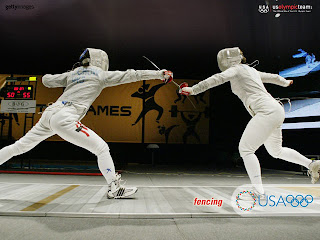 The Olympic games are fast approaching, and while it is a given that China will win the medal count (the home team always takes home more gold than they usually do, and China is a powerhouse,) the United States will do well in their traditional areas: basketball, softball, baseball, swimming, and track & field.
But there's another event where they are nearly guaranteed to excel: women's sabre. The women of the USA Fencing team have three of their four sabrueses ranked 2, 3, and 4 in the world. They have World Championships under their belts and, if you click on the photo, a window will open showing the NBC video of the first ever women's sabre gold medal match in the Olympics. It's great to watch. The Chinese fencer, Tan Xue, is currently ranked #1 in the world.
There are three types of fencing based on the weapon used. Foil is most common, meaning this is the weapon with which most people start. There are a number of rules a fencer must follow, including those regarding etiquette, but the important thing is to score a touch before your opponent. For foil, the valid touch area is the torso and groin. Touching the legs, head, or arms does not count.
The longest weapon is the epee. Here the entire body is a valid target, including the hands and feet. Epee is the style used in modern pentathlon. Epee is my favorite style. Anyone can score at any time, even while defending an attack. With other fencing weapons the fencer must establish the attack (or right of way.)
With both foil and epee, only the point of the sword can be used to touch. Bouts with foil and epee can appear to be much more like "movie" fencing. Lots of parrying and lunging. Some people refer to fencing as physical chess. It is a sport of the mind and body. You need to think in a series of actions and counteractions well before they happen.
But then there is sabre. Sabre is the aggressive cutting version of fencing. It is lightning quick. If you're new to it, watching it can be confusing because you aren't sure who scored the touch. Sabre touches cover everything from the waist up, including arms and head, but not the hands. With sabre, however, slashing is allowed. This is why sabreurs seem to be relaxed when a bout begins, rather than in the formal en garde position. Attacking with only your point is a quick way to lose.
Gabe has fenced for a couple of years. He hasn't fenced so far in 2008, mainly because he needs to work harder to keep up with school, but we'll get him back out there. He loves it.
Fencing clubs welcome beginners and offer lessons. It is a great form of exercise, you'll firm up your bottom and legs and you'll improve your balance. Don't worry about equipment right away. At most place you need only by an relatively inexpensive fencing glove. The clubs provide weapons, masks, jackets and other safety equipment.
If you try it, let us know about it.
Sunday, April 27, 2008
Hungarian Goulash
 My mom made hers with elbow macaroni. It was loaded with tomato sauce. I didn't like it.
But at least once every week or two, this was our dinner. I was reminded of the dish when I recently read Graham Greene's The Honorary Consul. One of the supporting characters likes to have the goulash at the "Italian Club". I immediately thought of this regular childhood meal.
We all have them, the staples of the dinners of our childhoods. Besides this dreaded tomatoey concoction, we regularly had cube steaks, liver and onions, hot dogs and sauerkraut, kielbasa, hamburgers, instant mashed potatoes, real mashed potatoes, cans of peas, green beans (french cut), corn, creamed corn, succotash, and carrots. We had pots of navy, lima, pinto, or great northern beans quite often, too. My least favorite would have been the lima beans. My favorite meal was probably chicken and dumplings.
We rarely, if ever, had fish. Fried chicken came from the Hitching Post in Cincinnati. Of course, we had our share of White Castles (my mom worked there when I was a baby) and either Gold Star or Skyline chili. Hot dogs came from Kahn's, beer came from Hudepohl and sometimes Burger or Schoenling, not that we were served beer as children, I just remember my dad having this.
Each week, during the summer when I wasn't visiting my maternal grandparents in Kentucky, I had lunch with my paternal grandmother, Elnora, in Cincinnati. We would go pick up her paycheck at Walgreen's each Friday. I would eat at the lunch counter. Chicken-fried steak was my typical choice.
Food is pretty simple when you're a kid. You either like it or you don't. If you don't, you have a strategy for dealing with it. For goulash, I ate the beef first. Cleaned the sauce off the pasta as best I could and used heaps of water or Mountain Dew to keep the acidic tomato taste off my palate. It isn't like I had options. Skipping a meal wasn't going to work. Though I could have made a meal out of Oreo's in those days. (According to Jocelyn, I could do so today, too.)
Was there a meal that you particularly dreaded? How did you cope? Was there one that you really looked forward to having? Did your family have a routine for meals? Leave a description in the comments.
(photo from belly-timber, who sadly doesn't seem to be producing entries anymore.)
Saturday, April 26, 2008
032 - Buy a bugle and learn to play Taps
 I think the first time that I heard Taps was as a kid watching the movie No Time for Sergeants.
In it, Andy Griffith plays a country boy US Air Force recruit (kind of like Gomer Pyle is a country boy marine recruit.) There's a scene where he is in the barracks his first night when lights out is called. From outside, the lovely 24 note tune, Taps, is played. Airman Stockdale, Griffith's character, says thoughtfully, "Somebody brung their trumpet." It was a beautiful sound and it seemed to calm my emotions, even while watching a screwball comedy movie.
Then I heard it in 1975, when my young uncle, Albert, my teenage uncle, died while in the Marine Corps on a Navy ship off the coast near Thailand. I answered the door when the men in their dress uniforms came to tell my grandmother (I used to spend at least one day a week with her during the summer months.) When Al was buried with a full military ceremony, they did the 3 volley salute (seven rifles, fired three times) and the bugler played Taps in the distance.
I played trumpet in elementary school band for a few years, but gave it up. Now, I think I want to get a valveless bugle. I want to learn to play Taps.
It didn't help when about ten years ago I finally read From Here to Eternity by James Jones. (I can't recommend the book enough.) I lived in Hawaii for many years and knew the places Jones refers to very well. One of the main protagonists in the book, Private Prewitt, is the company bugler. He plays bugle like no other. No matter what people think of him, they are astounded when they hear him play. (If you can't read the National Book Award winning novel, then at least rent the movie made the following year.)
All my life, the desire to play bugle, especially Taps, has been ricocheting around my subconscious. I need to act on it, so here it is on the 101 in 1,001 list.
Please do not misunderstand. Taps is not a morbid tune. It is a short melody that practically forces calm and quiet. It centers one, causing introspection and thoughtfulness. The spiritual nature of the piece (especially for someone who isn't traditionally spiritual, like me) appeals to me. I feel the same way about certain classical and new age compositions, but for those, I don't hold out hope of learning how to perform them.
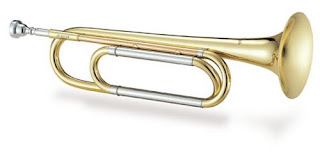
I linked an .mp3 of Taps to the image of the bugle. Click on the image and a window will open and it will play on your preferred applications (winamp, media player, etc.)
Friday, April 25, 2008
Historical self-help, a commentary, #1
 From The Art of Worldly Wisdom by Baltasar Gracian, published in 1647:
1. Everything today has its point, but nothing is more important than becoming a person. More is required to produce one wise person than used to be required for seven; and more is needed to deal with a single individual in these times than with an entire population in the past.
This is the opening salvo from Gracian in a book that contains 300 such entries. This is one of the weaker ones, mainly because of its generic introductory nature.
What I like about this paragraph is the human conceit that one's time is so much more complex and difficult than any earlier time. I don't know if "seven" is from an idiom of 17th century Spain but it serves to show that Gracian wanted to make his audience feel that they have a great responsibility for themselves. He makes the ratio even greater for our responsibility in dealing with others.
The real importance of this paragraph is in the initial sentence. Everything has meaning, art, commerce, nature, science, religion, philosophy, etc. "But nothing is more important than becoming a person." Aren't we all persons? Isn't that just another word for human?
It is, but in this context, Gracian is talking about our character and our individual personalities. We'll see as we review this book that he focuses on how to behave and get along in the world. Clearly, he believes if we focus on correct behavior, we'll have a far better go of it here on Earth. And a better go of it, to me, is what happiness is all about.
Surprisingly, his advice isn't all that dated. As a matter of fact, a lot of so-called self-help gurus have probably just rewritten Gracian's wisdom, maybe even unknowingly. I'm not charging anyone with plagiarism.
This commentary will be a periodic thing. I'm not promising a post per day on this one. And this feature will not be limited to this book, though most everything will be pre-20th century (or at least in the public domain!)
Thursday, April 24, 2008
A song you won't remember - Cinderella by Firefall


Here we have a song from my tween years, by Firefall called Cinderella. This is soft rock mixed with pop country. Not really my thing, but I always enjoyed Firefall. Their lyrics stood out for me, especially with this song.
We're told of a young girl who falls for the narrator, a man who disdains her so-called love, yet is still willing to have sex. She gets pregnant and he gets angry, mainly over finances, and sends her away. There is plenty of understated irony here. The notion that she doesn't know what love is, yet this shallow guy does? When he finds she's pregnant, he seems worried about how he'll get the Camaro running and repainted with a kid around.
After a musical bridge, with a lot of "no no no" repetition where the singer/narrator seems to be trying to convince himself that he was in the right, we come to the final verse. Here we discover an older man contemplating possible regret, maybe even remorse or guilt over having abandoned a young woman and his son. Somehow he finds a way to rationalize his wrong by blaming her for not leaving sooner.
The oddly soothing synthesizers, harmonica, and guitars belie the lyrical content of this song. But it works without being a cringing country message song or an intentionally misogynistic pop tune.
It is one of my favorite songs of the '70s and it takes me back to a time that I thought would always be filled with regret for me. Things change. Things are what they are. What is important is how we respond to them. We have to forgive ourselves especially if we want to be forgiven.
Cinderella could have left earlier but she didn't. The man could have kept them all together but he didn't. The boy might or might not have had a happy childhood. None of those decisions can be reversed.
The question is: what are we going to do now? The present decisions are the important ones.
Wednesday, April 23, 2008
100 - Do the taxes without filing for an extension
 It has happened every year for the last 18 years. April 15th (or whatever day is Tax Day for a given year) rolls around and I sit down to do what I have put off since late January when the W-2s arrived: I fill out the filing extension form and mail it in.
Then I fret about doing the taxes for the next three to six months. The undone paperwork stays in the back of my mind, gnawing at my happiness and for nearly two decades I've attacked it with the poorest weapon in my arsenal: I procrastinate.
This is simply stupid on my part. I need to get the taxes done, the sooner the better. If I owe, I can put off filing until the last day, but otherwise, just do them.
That's why, task number 100 on my 101 Things in 1,001 Days is doing the taxes without filing for an extension each year. Even on this list I nearly put this task off until the end.
And this year, I did them. I did my taxes with two weeks to go. They took me a long time to do because of some interesting income from 2007, but I got them finished.
Next year's will be even tougher, especially if we move. Even if I have to hire an accountant, I'm still taking credit for completing this task.
Does anyone else have this problem? How do you make yourself do it?
